More on decolonising
The sad loss of Neil Davidson

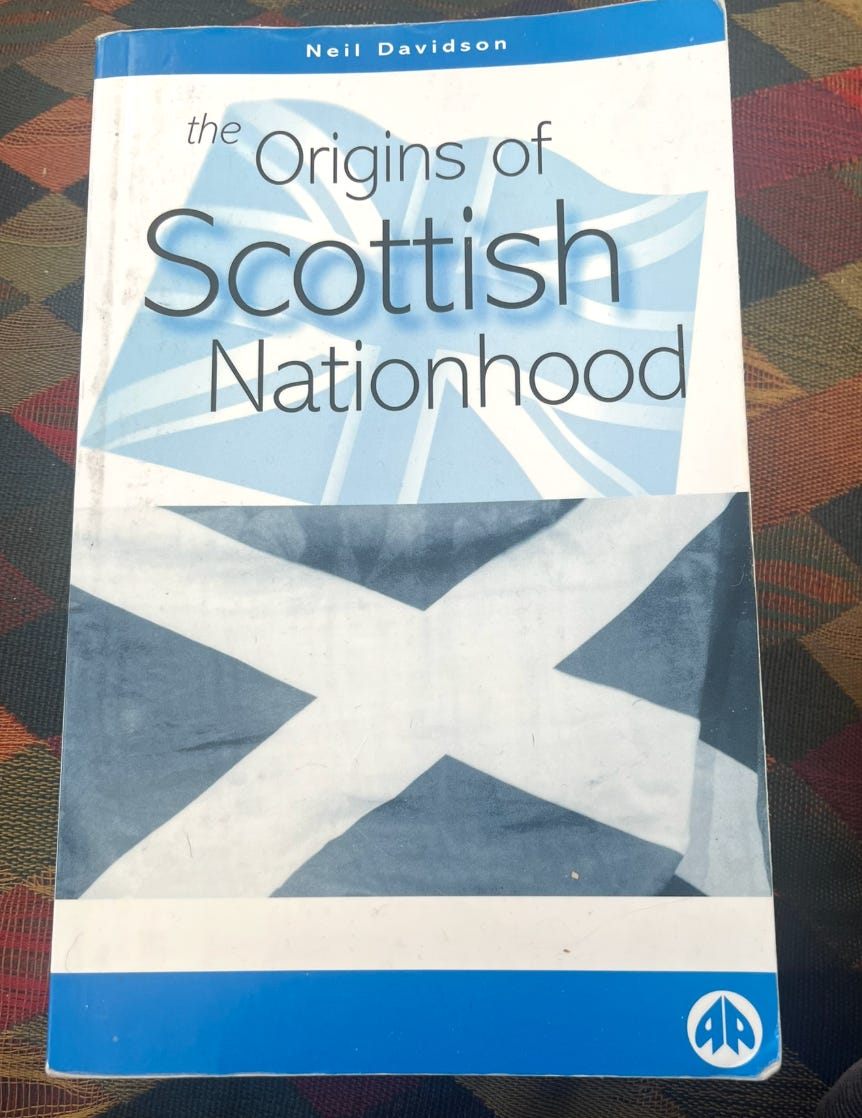
I’ve just finished reading Neil Davidson’s The Origins of Scottish Nationhood, published in 1999, and it’s made me sad that we lost him to a brain tumour in May 2020, when he still had a massive amount to contribute to the ongoing debate about Scottish Independence. In particular it would have been fascinating to read his take on the decolonisers who have since arrived on the scene, offering an almost magic solution to our current tragic situation.
In summary, Sara Salyers and others tell us that in 1707 our Scottish nation was colonised by its larger English neighbour, and has remained a subjugated people ever since. We’ve been through numerous wars, famines, the Clearances, the industrial revolution, and perhaps most important, our ancestors’ active participation in colonising other peoples and helping to create the British Empire. Although we’ve fought together, worked together, intermarried, moved north and south, welcomed new migrants and migrated ourselves, those of us north of the Tweed are living in a colony.
But there’s more. Somehow, despite Scotland producing some of the world’s greatest philosophers and political analysts from the Enlightenment onwards, our colonial status has passed us all by for over three centuries. Unlike the populations of every other colony, we Scots haven’t worked out that we’ve been living in one! It’s notable that at no point does the highly intelligent and analytical Neil Davidson consider the suggestion that we might be.
Neil Davidson’s book isn’t a quick, or an easy read. Hardly ever does one see such a fully referenced analysis; every major proposition is backed by notes, forty pages of them. He challenges some assumptions that are completely fatal to the decolonising argument.
The starting point is an investigation into the extent to which Scots at the end of the Seventeenth Century saw themselves as a single nation, given the massive Highland/Lowland divide. He goes on to argue very convincingly that our ancestors’ feeling of Scottishness was formed in the period from 1750 to 1850. Much was the result of the efforts of Sir Walter Scott among others. But any feeling of nationhood was as a self-awareness that we were Scots within Great Britain. He presents us with a mass of statistics about matters such as Scots massive participation in the British Empire, demonstrating that we didn’t take part as akin to slaves; indeed we were rather good at exploiting plantations ourselves.
As a lifelong communist, he sees the notion of brotherhood along class lines; Scots and English weavers feeling akin against the exploiters who arrived with industrialisation and mechanising. This is of course at the root of the position of the left against Scottish Independence, and it’s interesting that he became a supporter. Incidentally, today’s announcement that the Your Party Scotland also supports it is also puzzling in the context of “Workers of the World Unite”. One wonders what went on behind the scenes between Jeremy Corbin and Craig Murray.
I won’t lengthen this piece by repeating what I’ve expressed before; my previous efforts are listed below. In the light of the work done on the events around 1707 by Professor Robert Black I’m happy to amend my understanding that in legal terms the unwritten Scottish constitution was subsumed under the English one. Essentially the old Scottish doctrines, for example desuetude, disappeared, a small cohort of Scots were admitted to the English Parliament, and matters continued as they always had there. But note, he doesn’t say that Scotland is now a colony and thus qualifies for recognition as such by the United Nations.
Apart from this clarification, I stand by everything I’ve written before. As I have consistently argued, not all Non Self Governing Territories are colonies, and there is a perfectly valid route to establishing Scotland’s statehood in International Law via the International Court of Justice if necessary, based on what I’ve described as pure self-determination. The task of persuading the relevant UN Committee to register Scotland as a colony is an impossible, but also an unnecessary task. Why choose it? What are the motives behind those seeking to do it? Failure would distress countless people who had placed their trust in those promoting it, but would leave everyone in utter despair when they felt that there was no way to avoid going down with the failing UK state.
References
Is this the end of Liberation/Salvo
Over on Twitter, the Liberation Scotland Committee have responded to this post as follows:
“Please realise Eoghann that the term Non-Self-Governing Territory is the very definition of a colony in international law, and it is misleading to suggest otherwise. There is equally no point in talking about something you mysteriously call "pure self-determination" when the term has no meaning in international law. There exist internal and external self-determinations, and entitlement in law to the latter, i.e. to internationally-recognised statehood - restored statehood in Scotland's case - is entirely dependent on establishing dependency, or colonial status. You're not alone in not understanding this - neither the SNP nor Alba understands, or acknowledges it either. Perhaps you should engage with Liberation Scotland to help clear up some of these ideas.”
I have responded as follows:
Thank you for engaging with me; I am happy to do so, but suggest that had you read the articles referenced in my post, you would have found what I mean by, for example, “pure self-determination”. There’s no mystery. My detailed position is accessible here: https://macualraig.substack.com/p/routes-to-independence
My article contains nothing original; it was the culmination of research done over several years. My references extended from Lord President Cooper to Professor Marc Weller. Later it was a relief to find Professor Robert MacCorquodale broadly in agreement in his opinion commissioned by Alba.
My late friend Iain Lawson commented “Ewan wrote this in August 2021. In other words he saw well in advance where the failed debacle of the SCOTS GOVERNMENT application to the Supreme Court was going to end. He is not saying “told you so” but I am.”
https://yoursforscotlandcom.wordpress.com/2023/06/29/routes-to-independence/
I’d be interested to know if @LiberationScot have support from any legal academic for the position that the only route to Scottish statehood is via persuading the UN to add Scotland to the existing list of colonies and then decolonising us.
Forgot to add that I enjoy Ewan's writing, though not always agreeing entirely. This is from the time when the late and much missed Iain Lawson published Ewan's thoughts from time to time.